« Le travail est une forme d’amour »
Taxi Driver« Le travail est une forme d’amour » is Travis’s recurring conviction that labor can give shape and value to an otherwise unsettled life. First formed on a cold, miserable day in New York, the idea moves between practical necessity and moral aspiration: taxi driving earns money and occupies his sleepless hours, but he also imagines work as something offered to other people, to himself, and to the world. Its return after his crisis makes the phrase more than a rationale for taking a job; it becomes a fragile measure of how he might live without weapons.
Origin and Meaning
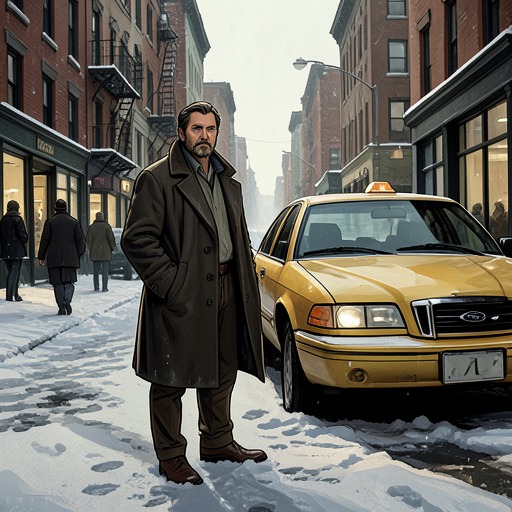
The thought comes after Travis sees Ashley, a distressed South Carolinian who has worked in New York for ten years and fears that losing his job will leave him homeless. Travis is struck by the misery visible on people’s faces and by Ashley’s anger at being recognized during his lunch break. On the cold, windy day that follows, Travis reflects that unstructured free time can take a person in a bad direction. He links being occupied with loving life, and imagines labor as giving something to others, to oneself, and to the world.
That ideal is also a practical answer to his circumstances. He has some money left from his army service but knows it will not last; he seeks a taxi licence and, a few days later, goes to the Manhattan Central office looking for work. He contrasts taking a job with spending all his free time watching pornographic films, while his insomnia keeps him awake through the nights. Work promises income and routine, but also a direction for hours that otherwise feel empty and difficult to bear.
The Work of Driving
Driving gives Travis a demanding schedule and a particular place in the city. He starts in the movie district, then grows tired of its customers, whom he finds more irritating and unpredictable than junkies or prostitutes. He distinguishes among passengers by their habits and expectations: East End customers are often stingy, while visitors from Kenosha expect him to know an assortment of obscure things. The job exposes him to people, but that contact does not automatically become the generous service the phrase might suggest.
The contrast with Maxey, a Bronx driver with thirty years’ experience, sharpens the point. Maxey can talk to passengers, offer advice, tell stories about his grandchildren, and discuss celebrities he has driven. Travis rejects the expectation that he should provide information about weather, flights, films, or restaurants. He is not, in his view, there to act as a guide. Taxi work brings him into continual proximity with strangers, yet he resists the social and emotional demands that might turn that proximity into connection.
Rain changes the practical terms of the job. Travis says he began work in March, during weeks of wet, humid weather, and that drivers can take whoever they want and go wherever they want in such conditions. In the depot’s saying, rain makes the taxi driver the city’s boss. The line gives the work a temporary authority over movement through New York, even as Travis remains tired, poorly paid, and subject to the risks of the streets.
He works from six in the evening until six in the morning, sometimes until eight, without a break. The long shifts keep him occupied and can bring in two hundred dollars a week, sometimes two hundred and fifty, with more from extras. The movie district’s higher earnings come with the danger of getting caught. Back at his apartment, where a clogged sink, cockroaches, and accumulated pornography make little invitation to linger, he mostly collapses and sleeps when he can. The job supplies money and consumes time, but its cost is physical: he becomes exhausted, his back hurts from his injuries, and he has little time to write in his notebook or see even one film a week.
Work, Danger, and the Wish to Matter
As Travis’s relation to work shifts, the taxi also becomes a means of moving through places where he expects danger. While carrying weapons and thinking about how to remain alert, he begins driving in northern Black neighborhoods around 128th Street and Amsterdam Avenue. He says he wants to know what would happen if he had to use the guns, and to make his dream visible to himself. Yet the encounters he describes there are uneventful: people are polite, tip him, and mind their own business.
His routes extend through Harlem and Seventh Avenue, past bottles on the street and crowded Lenox Avenue, then down the Lower East Side toward Tompkins Square, B Street, and Avenue B. He presents himself as roaming among teenagers and solitary people, inviting the night to admit him into its darkness and make him real with his weapon. He also says he wants to become somebody, a celebrity who enters history. In this phase, work still keeps him moving, but its promise of meaningful occupation is entangled with a project of danger and recognition. The capacity to drive anywhere does not, by itself, lead toward the human generosity he once imagined labor could express.
The tension becomes visible in his attempt to get Iris out of her situation with Sport. Travis tells her he has come to take her away, but Iris says that she lives there; later, she explains that when she is not high she has nowhere else to go and that the people around her protect her from herself. At breakfast the next day, Travis imagines that they might make an effort to be friends, while Iris says she does not want to return to parents who hate her. His wish to help is real, but his understanding of what help means does not settle the question of what Iris wants. Read beside his belief in work as giving, the encounter reveals a limit: good intentions do not ensure that another person experiences an offered intervention as care.
Return and Reversal
After the violent events, Travis returns to driving. The phrase recurs as he describes work as a form of love directed toward himself, at a time when there is not much work or love around him. That formulation draws the idea inward: labor is no longer chiefly described as something given to the world, but as a way to sustain himself amid an absence of affection and purpose.
For a time, the other drivers call him Killer, a reputation that eventually fades. Travis says he has stopped carrying weapons and that someone with his temperament does not need them. The contrast gives the returning phrase its weight. Earlier, his working routes were used to approach danger and test the reality of his armed fantasy; now he presents ordinary driving, without weapons, as a way to go on. Work does not erase the violence or prove that his earlier ideal has been fulfilled. It offers instead a modest, recurrent practice of self-preservation, holding together the need to earn a living and the hope that being occupied might still count as a form of love.